
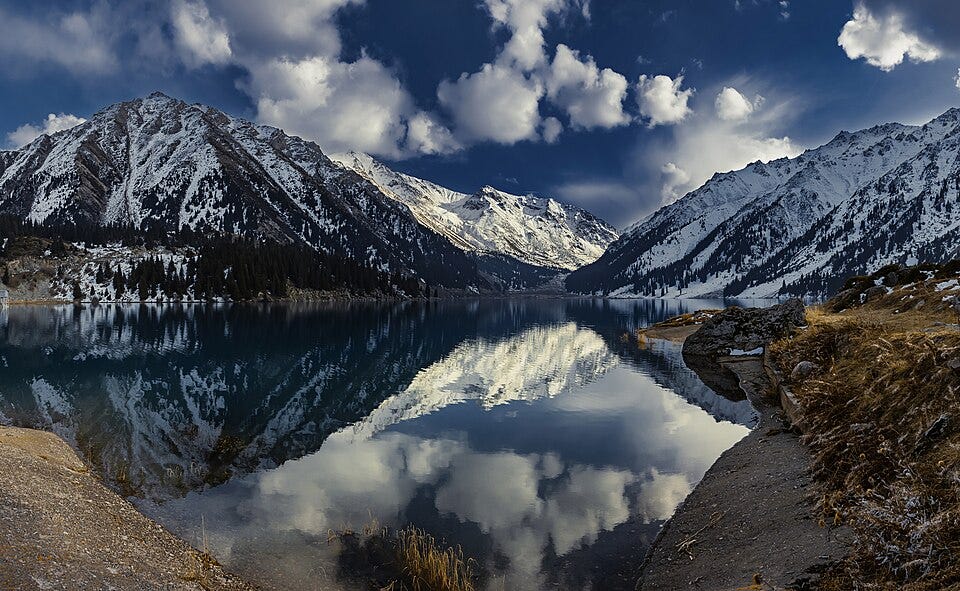
Big Almaty Lake in late autumn — snow already on the Trans-Ili Alatau, grass gone over. This is what the second half of October looks like, and it's exactly why you want to be here two weeks earlier.
Best Time to Visit Almaty & the Tian Shan (Autumn Is the Sweet Spot)
Almaty gets described two ways and both are wrong on their own. Summer people call it a hiking city. Winter people call it a ski city. Neither mentions the eight or so weeks between them, which is when the place is actually at its best — and, not coincidentally, when almost nobody writes about it.
The short answer: mid-September to mid-October is the best time to visit Almaty. Days sit in the mild range, the Tian Shan turns gold, the canyon roads are dry, and the summer crowd has gone home without the ski crowd arriving yet. If you can only go once, go then.
Here’s the longer version, including the part most guides skip.
What autumn actually does to the weather
September in Almaty still runs warm — average highs sit around 24°C before dropping to roughly 16°C across October. That drop is the whole story. Temperatures typically fall from around 20°C at the start of October to about 13°C by the end, with nights between 2°C and 8°C, and snow usually falls on about two days during the month. October weather - Autumn 2026 - Almaty, Kazakhstan +2
So Almaty weather in October isn’t one thing. The first ten days are a warm autumn. The last ten are early winter with the heating on. Pack for both and you’ll be fine; pack for the average and you’ll be wrong twice.
The upside: September is Almaty’s driest month, and October only brings around 60mm of rain across roughly ten days. Compare that to spring, which is genuinely wet, and the case for autumn travel in Kazakhstan gets easy. Weather Atlas
The foliage window, and how narrow it is
The reason autumn is the sweet spot rather than just a good season is the colour. The Tian Shan spruce stays dark, but the aspen, birch and larch in the gorges go through a two-week gold that photographs like nothing else in Central Asia.
Roughly:
Mid-September — colour starts high, above 2,000m. Kolsai and Big Almaty Lake turn first.
Late September to mid-October — the main event. Colour drops into the mid-altitude gorges and the Charyn approach.
Mid to late October — the city parks turn. Panfilov Park and the Arbat are worth an afternoon on their own.
Late October onward — first hard frosts, thinning colour, early snow on the passes.
If foliage is your priority, aim for the last week of September through the second week of October and accept that mountain weather doesn’t run on a calendar.
The one date that trips people up
This is the practical thing worth the price of the post. Shymbulak’s 2026 summer season runs through 18 October, after which the lifts go into staged maintenance before the ski season opens. The resort has confirmed the summer season runs to October 18, and in a normal year the Medeu–Shymbulak gondola and the Combi chairlifts close in overlapping blocks through late November ahead of winter. ShymbulakShymbulak
Translation: if you arrive on 22 October expecting to ride the gondola up to the Talgar Pass for the views, you may find it shut. Not snowed in — just closed for servicing. Skiing itself usually doesn’t begin until mid-November. Late October is the genuine dead zone in Almaty’s mountain calendar, and it’s the single strongest argument for going in the first half of the month instead of the second. Uzgen
Check the resort’s own schedule before you book flights. It shifts by a week or two each year.
Charyn Canyon and the Kolsai–Kaindy loop
The two-to-three-day loop east of the city is the reason most people come, and autumn suits it better than summer.
Charyn Canyon — the red sandstone gorge known as the Valley of Castles, roughly 200km east of Almaty. In July it’s an oven. In October it’s a pleasant walk with low, warm light hitting the rock in the late afternoon, which is exactly when you want to be down in it.
Kolsai Lakes — three alpine lakes in a spruce gorge near the Kyrgyz border, often called the blue necklace of the Tian Shan. The lower lake is an easy walk-around; the hike to the second lake is the real one. Most people overnight in Saty village and do it properly.
Kaindy Lake — the sunken forest. The lake formed in 1911 when an earthquake triggered a landslide that dammed the valley at around 2,000m, and the drowned Tian Shan spruce trunks still stand out of the water. It’s Kazakhstan’s most-photographed image and it deserves it. The access track from Saty needs a 4x4 — there’s a river crossing, so either book a vehicle with a driver in the village or go with a tour. OneRoadTripOneRoadTrip
Autumn advantage: the road is dry, the light is long and low, and you won’t be sharing the Valley of Castles with four coaches.
Big Almaty Lake — read this before you plan around it
Big Almaty Lake sits about 28km south of the city inside Ile-Alatau National Park at roughly 2,510m, framed by the glaciated peaks of the Trans-Ili Alatau. It’s the classic half-day trip from Almaty and it is genuinely spectacular in autumn. Kazakh Travel
But it isn’t a casual stroll. The lake lies near the Kazakhstan–Kyrgyzstan border, passport checks can happen at posts along the access road, and in some periods walking along the shoreline is restricted — visitors usually look from designated viewpoints above the water. Border guards take the zone seriously; you generally view the lake from the road, camping nearby isn’t permitted, and hikes onward to the peaks and glaciers may need permits from the migration police. It’s also Almaty’s main drinking water source, so swimming is prohibited, and there’s a national park entry fee. Big Almaty Lake Guide: How to Visit from Almaty | Kazakh Travel Blog +2
Bring your passport. Treat it as a viewpoint trip, not a hiking day, unless you’ve arranged permits in advance. And know that a 5.3km organised tourist trail to the lake is planned for completion by the end of 2026, so access conditions may shift while construction is underway. Kazakh Travel
The city half of the trip
Almaty is a genuinely good city and autumn is when it’s most comfortable to walk.
Green Bazaar — best in autumn, because autumn is harvest. Apples, dried apricots, horse sausage, camel milk, barrels of pickles.
Zenkov Cathedral in Panfilov Park — the wooden cathedral, at its best with yellow leaves on the ground around it.
Kok Tobe — cable car up the hill for the city-against-the-mountains view. Go on a clear morning after rain.
Medeu — the high-altitude ice rink below Shymbulak, typically open from October through March. In late October you can skate at the rink while the gorge below is still gold. That’s a very specific pleasure and it only exists for a few weeks a year. About Kazakhstan
The apples — Almaty’s name is bound up with apples, and the wild ancestor of the domestic apple grows in these foothills. In autumn that’s not trivia, it’s lunch.
September vs October vs November, plainly
September — warmest, driest, most reliable for high-altitude hiking. Colour only starts at the end. Best if you want to trek.
Early-to-mid October — the sweet spot. Colour at its peak in the gorges, mild days, dry canyon roads, thin crowds, lifts still running until the 18th. Best overall.
Late October — beautiful but awkward. Lift maintenance, cold nights, first snow on passes, ski season not open. Go only if the city and the canyons are your priority.
November — skip unless you’re skiing, and even then wait for the season to actually open.
Entry, money and getting around
Entry is easier than people expect. Citizens of around 56 countries — including the US, UK, Canada, Australia and the whole EU — enter visa-free for up to 30 days per visit, capped at 90 days in any 180-day period. Your receiving party, typically your hotel, must file an arrival notification with migration authorities within three working days, including for visa-free visits — ask for confirmation. The QazETA travel authorisation launched as a pilot in 2025 and remained optional-but-recommended through 2026, so check its status before you fly. Kazakhstan Visa & Entry Requirements: 2026 Guide +2
In the city, Yandex Go is the default for taxis and it’s cheap. Carry some tenge in cash for park fees and village guesthouses. And budget more layers than you think: the temperature gap between the city and a 2,500m lake is large, and it gets larger through October.
Who autumn isn’t for
Be honest about this. If you want high-altitude multi-day treks above 3,000m, the stable window is July to early September and autumn is already closing it. If you want to ski, come in January. If you need guaranteed dry weather for a tight itinerary, September beats October.
Everyone else — anyone who wants the canyons, the lakes, the colour and a walkable city, without either the summer heat or the winter lift queues — should be looking at the last week of September and the first two weeks of October.
The bottom line
The best time to visit Almaty and the Tian Shan is late September to mid-October. The weather is mild, the gorges are gold, the canyon roads are dry, and the crowds have thinned. Book the first half of October rather than the second, check Shymbulak’s lift schedule before you commit, and bring your passport to the lake.
The itinerary version of this — seven days, Charyn, Kolsai, Kaindy and the city, with the driving actually worked out — lands Thursday.
7. AEO FAQ
What is the best time to visit Almaty?
Late September to mid-October. Days run roughly 13–20°C, the Tian Shan gorges turn gold, the canyon roads are dry, and summer crowds have left before the ski season arrives.
What is the weather like in Almaty in October?
It changes fast. Highs average around 16°C for the month but fall from roughly 20°C at the start to about 13°C by the end, with nights between 2°C and 8°C and around two days of snow. Pack for two seasons.
Is Almaty worth visiting in autumn?
Yes — it’s arguably the best season. You get foliage in the mountains, comfortable walking weather in the city, dry access roads to Charyn Canyon and the Kolsai Lakes, and lower prices than peak summer or ski season.
When do the leaves change in the Tian Shan near Almaty?
Colour starts above 2,000m in mid-September, peaks in the mid-altitude gorges from late September to mid-October, and reaches the city parks in mid-to-late October.
Is Shymbulak open in October?
Partly. The 2026 summer season runs through 18 October, after which lifts close in stages for maintenance before the ski season opens around mid-November. Late October is the gap. Check the resort’s schedule before booking.
Do I need a permit for Big Almaty Lake?
Bring your passport — the lake sits near the Kyrgyz border and document checks happen at posts on the access road. Shoreline access can be restricted, camping isn’t permitted, and onward hikes to the peaks may require permits from the migration police. There’s also a small national park entry fee.
Do I need a visa for Kazakhstan?
Most visitors don’t. Citizens of around 56 countries, including the US, UK, EU, Canada and Australia, enter visa-free for 30 days per visit, capped at 90 days per 180. Your hotel must file an arrival notification within three working days.
Can you visit Charyn Canyon and the Kolsai Lakes in October?
Yes, and October suits them better than summer. The roads are dry, Charyn is comfortable rather than baking, and the light is low and warm. The Kaindy Lake track from Saty still needs a 4x4 with a river crossing.
How many days do you need in Almaty?
Seven is the right number: two or three in the city, two or three for the Charyn–Kolsai–Kaindy loop with a night in Saty, and a day for Big Almaty Lake or Medeu and Shymbulak.