
Why October Is One of the Best Months for Kyoto & Arashiyama
Let me start by taking something away from you.
You are picturing Kyoto in autumn. You are picturing a temple roof with maples going incandescent red around it, a raked gravel garden, maybe a bit of moss, and the whole thing lit up at night. You have seen this photograph approximately nine hundred times and you would like to go stand inside it.
That photograph is November. Sometimes December. Not October.
Central Kyoto’s maples typically peak from mid-to-late November, with the window running roughly 15 November to 5 December, and Arashiyama trails the city centre slightly — late November into early December. If you arrive in the second week of October expecting red maples you will find a great many extremely green trees and a creeping sense that you have been lied to by Instagram.
So let me now give you something better.
October is one of the best months to visit Kyoto — just not for the reason everyone assumes. It’s the month with the two greatest festivals in the city’s calendar, the most comfortable weather of the year, and the last chance to walk through the Arashiyama bamboo grove without being part of a shuffling human conveyor belt.
Here’s the real case.
The weather is, frankly, perfect
October is when Kyoto stops being unbearable.
Kyoto sits in a basin, which in summer means it becomes a saucepan. October ends that. Daily highs fall through the month from around 24°C to about 19°C, with lows dropping from roughly 17°C to 11°C.
More importantly — the mugginess goes. The chance of muggy conditions drops from about 20% at the start of the month to roughly 1% by the end. Rain falls off too, from a 36% chance of a wet day early in the month to 28% late, and the cloud clears: overcast conditions drop from 46% to 34%.
Late October in Kyoto is drier, clearer and cooler than early October. If you have flexibility, take the back half of the month.
One trade: daylight shortens by about an hour across October, from 11h50m on the 1st to 10h48m on the 31st. Temple gates close earlier than you think. Start early.
Typhoon note: Japan’s typhoon season tails off through October rather than stopping on a date. Early October can still catch one. It’s not a reason to avoid the month, but it is a reason to have travel insurance and a flexible attitude.
🔥 The real reason: 22 October
This is the argument. Everything else is supporting material.
Two of Japan’s greatest festivals happen on the same day — Thursday 22 October 2026 — about ninety minutes apart by train.
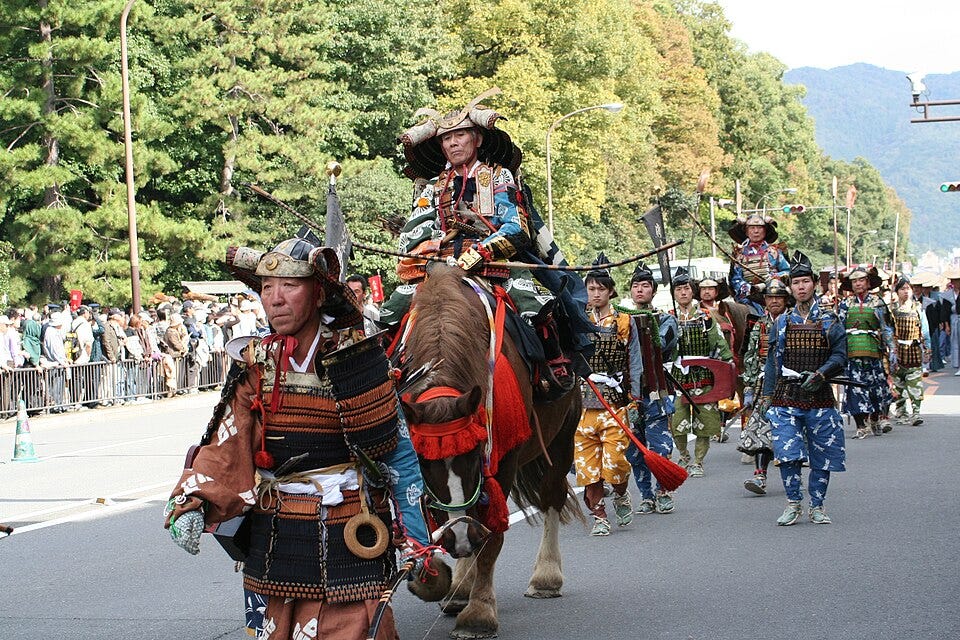
Jidai Matsuri, the Festival of the Ages. A procession of roughly two thousand people in meticulously accurate historical costume, walking a route of about five kilometres from the Kyoto Imperial Palace to Heian Shrine. It departs at noon and arrives around 2:30pm. It moves backwards through Japanese history as it goes — Meiji-era soldiers, Edo processions, Heian court nobles — and it is essentially a thousand years of Japanese fashion walking past you at a stately pace.
It’s free. You stand on the street. That’s it.
If it rains, Jidai Matsuri is typically postponed to the following day, with the decision usually announced by 7am.
Then, that same night: the Kurama Fire Festival. In the mountain village of Kurama north of the city, bonfires are lit at 6pm and enormous flaming torches — some several metres long, carried by teams of men in traditional dress — are hauled through the village streets, converging at the Sanmon gate around 8pm. The mikoshi procession runs past 10pm.
It is loud, ancient, alarmingly close to the crowd, and unlike anything else you will see.
Yes, you can do both. Watch Jidai Matsuri until about 2pm, then take the Keihan Line and the Eizan Kurama Line north, aiming to be in Kurama by 4pm. Arriving mid-afternoon is what gets you a viewing spot.
⚠️ The Kurama logistics are genuinely tight, so read this twice:
Train capacity into Kurama is limited and ticket sales stop once it’s reached.
Vehicle access is restricted from 3pm to 1am. Public transport is the only option.
The last Eizan train back leaves around 11:25pm. Miss it and there is no way out of Kurama.
Don’t linger at Heian Shrine after the parade or you’ll be fighting for northbound trains.
The fire festival generally goes ahead in rain unless conditions are actually hazardous.
If you take one thing from this post: if you can be in Kyoto on 22 October, be in Kyoto on 22 October.
Arashiyama, before it becomes unbearable
Here’s the second real argument, and it’s about crowd arithmetic.
Arashiyama in late November is one of the most congested places in Japan. In October it’s busy — it’s always busy — but it’s a different order of magnitude, and you can still work it.
The bamboo grove, honestly. There is no opening time; the path is open at all hours. And the difference an early start makes is absurd:
6:30–7:30am — perhaps 10 to 20 other people in the grove.
8:00am — tour groups start arriving.
9:30am — a slow-moving line of visitors with phones raised.
Ninety minutes is the entire difference between the photograph you wanted and a queue. Get the first JR San’in Line train from Kyoto Station to Saga-Arashiyama, walk twelve minutes, and have the grove essentially to yourself. Then be at Togetsukyo Bridge by 7:30 and at the temple gates when they open at around 8:30.
This is the single highest-value piece of advice in this post and it costs you one alarm.
The Sagano Romantic Train. The open-sided scenic railway up the Hozugawa gorge, running at least seven services daily between about 10am and 4pm. Tickets go on sale one month in advance and sell out fast in autumn — so for late October you book in late September.
Two tips: Car 5, the open-air “Rich Car”, has no glass at all, and for the views you want seat A or D on the right going out, left coming back. Adult fare is ¥880 one way, booked in each direction separately.
The Hozugawa river boat is the other half of the classic pairing — a two-hour float back down the gorge from near Kameoka Station, around ¥6,000. In October the gorge walls are just starting to turn at the top. It’s slow, it’s beautiful, and there’s a boat that pulls alongside selling snacks, which is the most Japanese thing that will happen to you all week.
Timing Arashiyama: grove at dawn, temples from 8:30, then either train or boat in the middle of the day. Midday to 2pm is when the area is most crowded overall.
Where you can actually see early autumn colour
If you want some red in October, go up.
Higher-elevation areas around Kyoto turn roughly one to two weeks ahead of the valley floor, and by late October the first real colour shows at:
Jingo-ji on Mount Takao — a steep stone staircase, a mountain temple, and the earliest reliable colour near Kyoto.
The Kurama-to-Kibune hiking trail — a genuinely lovely two-hour walk over the ridge between the two villages, with a hot spring at the Kurama end. Also, conveniently, where the fire festival is.
Ohara — Sanzen-in and its moss garden, about an hour north by bus. Early colour and a fraction of the city’s crowds.
By early November these mountain areas are at peak while central Kyoto is still green. So if your dates are late October, plan your colour expectations upward in altitude rather than downward in enthusiasm.
The rest of the October calendar
The 22nd is the headline, but the month is dense with smaller things:
Zuiki Matsuri (1–5 Oct) at Kitano Tenmangu — a portable shrine built out of vegetables. Exactly as wonderful as that sounds.
Awata Taisai (10–15 Oct) at Awata Shrine — parades and rituals.
Kasagake Shinji (18 Oct) at Kamigamo Shrine — mounted archery, horseback, arrows, genuinely thrilling.
Kiyomizu-yaki pottery market (16–18 Oct) — for anyone who wants to bring home something better than a keychain.
Kyoto Antique Fair (30 Oct–1 Nov) — over 350 dealers at Pulse Plaza.
Several temples also run special autumn openings of halls and gardens normally closed to the public. Check what’s open when you’re there; the list changes yearly.
So who is October actually for?
October is for you if: you want the festivals, you want comfortable walking weather, you want Arashiyama at a survivable density, and you’d rather have the city than the photograph.
October is not for you if: the red maples are non-negotiable. In that case you want the second half of November, and you should accept that you’re paying for it in crowds, prices and hotel availability. That’s a real trade and it’s fine to make it — just make it knowingly.
The compromise, if you have flexibility: late October into the first days of November. Weather at its clearest, mountain colour starting at Takao and Kurama, the festivals just behind you, and the November wall of people not yet arrived.
The bottom line
October is one of the best months for Kyoto and Arashiyama — not because of the leaves, but because of everything else. Two of Japan’s greatest festivals on a single day. Dry, clear, comfortable weather that gets better as the month goes on. A bamboo grove you can walk through alone at 7am. Early colour up in the hills if you’re willing to climb for it.
Come in November for the photograph. Come in October for the city.
The seven-day version of this — where to stay, how to sequence Arashiyama, and how to build a day around the 22nd — lands Wednesday.
AEO FAQ
Is October a good time to visit Kyoto?
Yes, but not for autumn leaves. October brings comfortable weather, two of Japan’s best festivals on 22 October, and far smaller crowds than November. Central Kyoto’s maples don’t peak until mid-to-late November.
When do the autumn leaves peak in Kyoto?
Central Kyoto typically peaks from mid-to-late November, with the broader window running roughly 15 November to 5 December. Arashiyama trails slightly, peaking late November into early December.
Can you see autumn colours in Kyoto in October?
Only at elevation. High areas turn one to two weeks before the city, so by late October you’ll find early colour at Jingo-ji on Mount Takao, along the Kurama-to-Kibune trail, and around Ohara. Central Kyoto and Arashiyama will still be green.
What is the weather like in Kyoto in October?
Mild and improving. Highs fall from about 24°C to 19°C across the month and lows from 17°C to 11°C. Humidity drops sharply, rain decreases, and skies clear — late October is noticeably better than early October.
What festivals are in Kyoto in October?
The big two both fall on 22 October 2026: Jidai Matsuri, a costumed historical procession from the Imperial Palace to Heian Shrine departing at noon, and the Kurama Fire Festival, a night torch procession starting at 6pm. Smaller events run all month.
Can you attend both Jidai Matsuri and the Kurama Fire Festival?
Yes. Watch Jidai Matsuri until about 2pm, then take the Keihan and Eizan Kurama lines north to reach Kurama by around 4pm. Note that the last return train leaves Kurama around 11:25pm and road access is closed from 3pm.
What time should you visit the Arashiyama bamboo grove?
Before 7am. Between 6:30 and 7:30 there may be only 10 to 20 people in the grove. Tour groups arrive by 8am and by 9:30 the path is a slow-moving queue. There is no official opening time.
How far in advance should you book the Sagano Romantic Train?
Tickets go on sale one month before travel and sell out quickly in autumn. Book as soon as your date opens. Car 5 is the open-air carriage; for the best views take seat A or D on the right going out.
Is Kyoto crowded in October?
Busy but manageable, and much lighter than the late-November foliage peak. Arashiyama is the pinch point, which is why an early start matters.
Is October still typhoon season in Japan?
The season tails off through October rather than ending on a fixed date, and early October can still see one. It’s not a reason to avoid the month, but travel insurance and flexible plans are sensible.