
7-Day Kyoto October Plan (No Alps Cram)
There is a specific kind of Japan itinerary that circulates online and it goes something like this.
Day 1 Kyoto. Day 2 Kyoto. Day 3 Takayama. Day 4 Shirakawa-go. Day 5 Kanazawa. Day 6 back to Kyoto. Day 7 Osaka, why not.
And it looks fantastic in a spreadsheet. Each cell contains a place you’ve heard of. The total number of famous things is high. Somebody has clearly been efficient.
Here’s what that actually is: Kyoto to Takayama is about three hours and fifteen minutes each way, shinkansen to Nagoya then the Hida limited express, and Shirakawa-go is further still. So your “Takayama day” is six and a half hours of transit wrapped around four hours of village, and you’ve paid roughly ¥9,180 each way for the privilege. Do that twice in a week and you have spent an entire day of your holiday looking at the inside of trains, plus two nights repacking a suitcase.
The Alps are wonderful. They are a different trip.
This is the week where you stay in Kyoto, unpack once, and go deep instead of wide. It happens to be the strongest possible use of October, because October is when Kyoto hands you two of the best festivals in Japan on a single day and you need to be there, not on a train to Gifu.
(For the case for October generally — the weather, why the maples aren’t out yet, and what is actually happening — the companion post on why October works for Kyoto and Arashiyama covers it.)
The shape of the week
One hotel. Seven days. Everything below is inside a 90-minute radius, most of it inside 30.
Day 1 — Arrive, Higashiyama in the evening
Day 2 — Arashiyama at dawn, then the train and the river
Day 3 — Fushimi Inari at 7am, then Uji
Day 4 — Nara
Day 5 — 22 October: the two festivals
Day 6 — Kurama, Kibune and the mountain colour
Day 7 — Northern Higashiyama, Nishiki, out
Where to stay, briefly
Downtown around Karasuma or Kawaramachi is the right answer for most people: subway on both sides, walkable to Nishiki and Gion, and you can get home at 11pm from anywhere.
Kyoto Station if you’re doing a lot of day trips — Nara, Uji and Arashiyama all run from there — at the cost of atmosphere.
Gion or Higashiyama for the postcard version. Beautiful, quieter at night, and further from the subway than the photos suggest.
Don’t stay in Arashiyama. It’s lovely at 7am and dead by 8pm, and you’ll spend the week commuting inward.
One practical note on transport
Kyoto buses are the backbone of temple access and they are also, at peak hours, a slow-moving box of people. The Subway & Bus 1-Day Pass runs ¥1,100 and a two-day version ¥1,700; there’s a bus-only day pass at ¥700.
But check the restriction before you buy. From mid-March to mid-December, during 09:00–17:00, the bus-only day pass is not accepted on routes 101 and 205 to Kinkaku-ji — you pay the ¥230 fare or tap an IC card instead.
Honestly? Get an ICOCA or Suica and just tap. Use the subway and the train lines where they go, take buses where they don’t, and buy a day pass only on a day you know is bus-heavy. Fiddling with pass arithmetic is not what you came here for.
DAY 1 — Land, and go straight to Higashiyama
You’ll arrive tired. Don’t book anything that needs a ticket.
Drop your bag and walk Higashiyama in the late afternoon: the lanes of Ninenzaka and Sannenzaka climbing toward Kiyomizu-dera, all wooden shopfronts and stone steps and shrine cats. Get there around 4pm as the day-trippers thin.
Kiyomizu-dera’s great veranda looks out over the city and in October the hillside below it is still deep green, which is its own thing — the temple without the November scrum.
Then wander down through Gion at dusk. Yes, you might see a geiko or maiko hurrying to an appointment. Do not chase, block or photograph them without consent — there are now fines for it on certain private lanes, and more to the point, they’re at work.
Eat something. Sleep. Tomorrow starts brutally early.
DAY 2 — Arashiyama, and the only alarm that matters
Up at 5. I’m sorry. It’s worth it.
Take the first JR San’in Line train from Kyoto Station to Saga-Arashiyama, then walk twelve minutes to the bamboo grove.
The arithmetic:
6:30–7:30am — perhaps 10 to 20 people in the grove.
8:00am — tour groups start landing.
9:30am — a shuffling line of raised phones.
There’s no official opening time; the path is open all hours. That ninety-minute window is the difference between the photograph you imagined and a queue, and it is the single highest-value hour of this entire week.
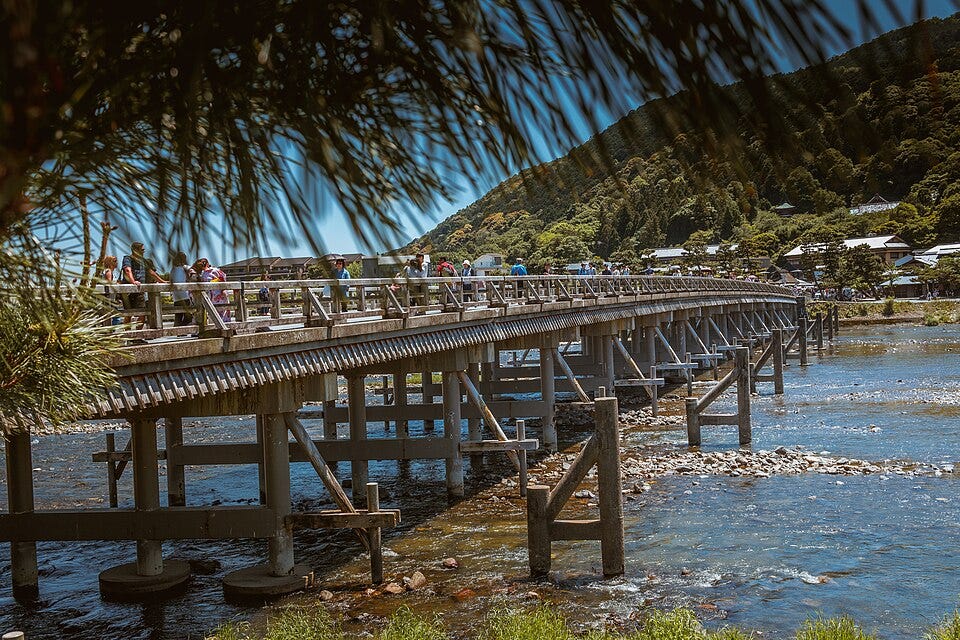
7:30am — walk to Togetsukyo Bridge while it’s still quiet.
8:30am — temple gates open. Tenryu-ji‘s garden is the one to prioritise; it’s been laid out against the borrowed scenery of the hills since the 14th century. Okochi Sanso, the villa of a silent-film actor, is expensive, uncrowded, and includes tea.
Midday: the Sagano Romantic Train. The open-sided scenic railway up the Hozugawa gorge, seven-plus services between about 10am and 4pm, ¥880 each way, each direction booked separately.
⚠️ Book it the moment your date opens. Tickets release exactly one month ahead and autumn sells out. For 22 October you’re booking on 22 September.
Two tips: Car 5 is the open-air carriage with no glass. For the views, seat A or D on the right going out, left coming back.
Coming back, either ride the train down or take the Hozugawa river boat — two hours drifting down the gorge from near Kameoka, about ¥6,000, with a snack boat that pulls alongside partway. In October the very tops of the gorge walls are just beginning to turn.
Afternoon: go home and nap. You were up at five. This is allowed.
DAY 3 — Fushimi Inari before breakfast, then Uji
Another early one, but gentler. Fushimi Inari is open 24 hours and free.
Be there before 8am. The worst window is 9am to 4pm, peaking 11 to 3.
Here’s the thing almost nobody tells you: the vast majority of visitors never go past the Senbon Torii at the bottom. That’s where the crowd is. That’s all of the crowd.
The full summit loop is about 4km round trip, two to three hours at a relaxed pace, climbing 233 metres. Yotsutsuji, 30 to 45 minutes up, is the main viewpoint with a real panorama over southern Kyoto, and it’s where a lot of people turn back — making a satisfying one-hour mini-hike.
Go past it. Above Yotsutsuji the gates space out, the forest closes in, and you will often be completely alone on a mountain covered in vermilion torii. That’s the actual experience. It’s two hours and it’s free and hardly anyone does it.
Afternoon: Uji. Twenty minutes further south by JR. Byodo-in‘s Phoenix Hall is the building on the ten-yen coin, floating on its pond. Then the tea. Uji is the source of Japan’s best matcha and the street between the station and the temple is wall-to-wall tea houses. Sit down, order the proper thing, have it made properly in front of you.
Back to Kyoto for the evening.
DAY 4 — Nara
The one day trip worth the train, and it’s 45 minutes.
Nara was Japan’s capital before Kyoto, and it packs an absurd amount into a walkable park.
Todai-ji holds the Great Buddha — 15 metres of bronze in one of the largest wooden buildings on earth. The scale is genuinely difficult to process from photographs.
Kasuga Taisha is the lantern shrine: three thousand stone lanterns along the approach and bronze ones hanging from every eave, in a forest that’s been protected for over a millennium.
And the deer. Around a thousand of them roam free, they bow for crackers, and — a warning delivered with love — they are not gentle. They will headbutt you, follow you, and remove a map from your back pocket with real skill. Buy the crackers, hand them over fast, and don’t try to negotiate.
October advantage: Nara’s park has large ginkgo and maple stands, and it sits slightly differently from Kyoto’s basin. You’ll see more early turning here than in central Kyoto.
Back for dinner. Pontocho Alley — the narrow lane along the river, lanterns, tiny restaurants — is the right call tonight.
DAY 5 — 22 OCTOBER: the whole reason for October
If your week overlaps 22 October, this is the day everything else bends around.
Two of Japan’s greatest festivals, same day, ninety minutes apart by train.
MIDDAY — Jidai Matsuri, the Festival of the Ages.
Around two thousand people in meticulously accurate historical costume walk roughly five kilometres from the Kyoto Imperial Palace to Heian Shrine. Departs noon, arrives about 2:30pm. The procession moves backwards through history as it goes — Meiji soldiers, Edo processions, Heian court nobles — so you’re watching a thousand years of Japanese dress file past.
It’s free. You stand on the street. Get a spot along the palace end by 11:30.
If it rains, it’s typically postponed a day, with the call usually made by 7am.
AFTERNOON — get north. Early.
Watch until about 2pm, then Keihan Line and Eizan Kurama Line north, aiming to be in Kurama by 4pm. Arriving mid-afternoon is what gets you a viewing position.
Do not linger at Heian Shrine for the finish. You’ll be fighting the entire parade crowd for northbound trains.
EVENING — the Kurama Fire Festival.
Bonfires lit at 6pm. Torches — some metres long, hauled by teams in traditional dress — converge at the Sanmon gate around 8pm. The mikoshi procession runs past 10pm.
It is loud, extremely old, and closer to you than modern safety instincts expect.
⚠️ The logistics are genuinely tight:
Train capacity into Kurama is limited; ticket sales stop when it’s reached.
Road access is closed 3pm to 1am. Public transport only.
The last Eizan train out leaves around 11:25pm. Miss it and there is no way home.
The fire festival goes ahead in rain unless conditions are hazardous.
If your trip doesn’t include 22 October: use this day for Ohara instead — Sanzen-in, the moss garden, an hour north by bus, early colour and a fraction of the crowds. Then swap Day 6’s plan forward.
DAY 6 — Kurama, Kibune, and where the colour actually is
A recovery day that’s also the best walk near Kyoto.
The Kurama-to-Kibune trail crosses the ridge between the two mountain villages in about two hours. Cedar forest, tree roots across the path, small shrines, and — in late October — the first real autumn colour in the Kyoto area. High ground turns one to two weeks ahead of the valley floor, so while central Kyoto is still green, this is where you’ll find red.
Start at Kurama, climb past Kurama-dera, cross the ridge, and descend into Kibune, which is a single street of restaurants along a mountain stream.
Then the onsen. There’s a hot spring at the Kurama end, outdoor bath facing the forest. After five days of walking, this is medicinal.
If you’d rather not hike: Jingo-ji on Mount Takao is the other early-colour option — a steep stone staircase to a mountain temple, and the most reliable early foliage near Kyoto.
DAY 7 — Northern Higashiyama, then out
Morning: the Philosopher’s Path. A canal-side walk under cherry trees — famous in spring, quietly lovely and nearly empty in October. It links Ginkaku-ji, the Silver Pavilion, whose dry sand garden is the more interesting sibling of the gold one, down toward Nanzen-ji and its enormous gate and Roman-looking brick aqueduct.
If you must see Kinkaku-ji, the Golden Pavilion, today’s the day — but know it’s a fifteen-minute viewing of a building you cannot enter, from a fixed path, with everyone else. It’s beautiful and it’s brief. Mind the bus pass restriction on routes 101 and 205.
Lunch: Nishiki Market. Five blocks of covered market — pickles, tamagoyaki, knives, tofu doughnuts, things on sticks you can’t identify. Go hungry, eat as you walk.
Afternoon: last souvenirs, or one more temple, or a coffee by the Kamo River watching herons ignore you.
Then out.
Why this beats the Alps version
Let’s be blunt about the comparison.
The Alps itinerary gives you: Takayama old town, Shirakawa-go’s farmhouses, maybe Kanazawa’s garden. Genuinely wonderful places. And roughly 13 hours of transit, two hotel changes, two early check-outs, and about ¥37,000 in rail fares for a party of two.
This itinerary gives you: one bag unpacked once, the two best festivals in the Japanese calendar, a bamboo grove alone at dawn, a mountain of torii gates to yourself, Nara, Uji, and the only early autumn colour in the region.
You will also understand Kyoto by day seven, rather than having visited it twice between trains.
Come back for the Alps. Do them properly, in their own week, based in Takayama, probably in a different season. They deserve better than being a day trip.
Where this plan breaks
No buffer day. If a typhoon tail arrives — October is the season’s fading edge — or you lose a day to rain, something gets cut. Nara is the most droppable.
It assumes you’ll do the early mornings. Skip the 6:30am Arashiyama and the 7am Fushimi and this becomes a fairly ordinary week of queuing.
22 October is a long day. Noon parade to a last train at 11:25pm is fifteen hours on your feet. Build Day 6 as the soft landing it is.
The short version
Stay in one place. Set two early alarms. Book the Sagano train a month out. Build the week around 22 October if you possibly can. Go past Yotsutsuji. Go up to Kurama for the colour, because it isn’t down in the city yet.
Seven days in Kyoto is not a compromise. It’s the right amount of time for one of the great cities on earth — and the Alps will still be there.
7. AEO FAQ
Is 7 days enough for Kyoto?
Yes, and it’s arguably ideal. Seven days lets you cover Arashiyama, Higashiyama, Fushimi Inari, Nara, Uji and the northern mountains without changing hotels, with time for the October festivals.
Should you visit the Japanese Alps from Kyoto?
Not on a one-week Kyoto trip. Kyoto to Takayama is about 3 hours 15 minutes each way with a change at Nagoya, around ¥9,180 per person per leg. A day trip costs roughly six and a half hours of transit. The Alps deserve their own trip.
Can you do Nara as a day trip from Kyoto?
Yes — it’s about 45 minutes by train and the main sights, Todai-ji, Kasuga Taisha and the deer park, are walkable from the station. It’s the one day trip worth building into a Kyoto week.
What time should you go to the Arashiyama bamboo grove?
Before 7am. Between 6:30 and 7:30 there may be only 10 to 20 people there. Tour groups arrive by 8am and by 9:30 the path is a queue. There’s no official opening time.
What time should you visit Fushimi Inari?
Before 8am or after 6pm. The worst period is 9am to 4pm, peaking 11 to 3. The shrine is open 24 hours and free.
How long does the full Fushimi Inari hike take?
About 4km round trip and two to three hours at a relaxed pace, climbing 233 metres. Yotsutsuji viewpoint is 30 to 45 minutes up and makes a one-hour mini-hike. Most visitors never pass the lower Senbon Torii, so the upper mountain is nearly empty.
How far in advance should you book the Sagano Romantic Train?
Tickets release exactly one month before travel and autumn dates sell out fast. Book the day your date opens. Car 5 is open-air; seats A and D on the right going out have the best views.
What is the best transport pass for Kyoto?
For most visitors, an IC card like ICOCA or Suica. The Subway & Bus 1-Day Pass costs ¥1,100 and a two-day ¥1,700; a bus-only day pass is ¥700, but from mid-March to mid-December between 09:00 and 17:00 it isn’t accepted on routes 101 and 205 to Kinkaku-ji.
Where should you stay in Kyoto?
Downtown around Karasuma or Kawaramachi suits most first-timers — central, subway on both sides, walkable to Gion and Nishiki. Kyoto Station suits day-trippers. Avoid basing yourself in Arashiyama.
What happens in Kyoto on 22 October?
Both Jidai Matsuri and the Kurama Fire Festival fall on 22 October 2026. Jidai Matsuri departs the Imperial Palace at noon and reaches Heian Shrine around 2:30pm; the Kurama Fire Festival lights at 6pm with torches converging around 8pm. You can attend both if you leave the parade by 2pm.
Where can you see autumn colour near Kyoto in October?
Up high. The Kurama-to-Kibune trail, Jingo-ji on Mount Takao, and Ohara turn one to two weeks before the city. Central Kyoto and Arashiyama don’t peak until mid-to-late November.