
7-Day Nepal Itinerary: Kathmandu, Pokhara & the Annapurna Foothills
Let’s deal with the elephant first.
Seven days is not enough for Nepal. Nobody who has been there will tell you otherwise. Everest Base Camp needs twelve to fourteen. The Annapurna Circuit wants a fortnight. Every trekking agency you email will gently suggest you take longer, and every single one of them will be right.
But you have seven days. You have a job, a finite allocation of annual leave, and possibly a person at home who has Opinions about how much of the calendar year you spend at altitude.
So here is the honest good news: there is a seven-day Nepal itinerary that works. Not a compressed version of a better trip — an actually complete one, with a proper Himalayan sunrise, two of Asia’s great cities, and a trek that doesn’t require you to acclimatise, carry a sleeping bag the size of a labrador, or be evacuated by helicopter.
It’s the Kathmandu Valley, Pokhara, and the Ghorepani–Poon Hill circuit in the Annapurna foothills. Let’s build it.
(For when to come, the companion post on the best time to visit Nepal covers the weather month by month and the permit rules. Short version: you’re reading this in the right month. Carry on.)
First: the rules changed, and you need to know before you book
Quick but non-negotiable.
Solo trekking is banned on Nepal’s regulated routes. You need a licensed guide from a government-registered agency for the Annapurna Conservation Area, and 2026 is the year enforcement became consistent at checkpoints. The Poon Hill circuit is inside ACAP. So: guide required.
This does not mean joining a group tour. It means one licensed person walks with you. You can still travel as a solo traveller — you just have company who knows the trail, the weather and what to do if you get a headache at 2,800m.
Permits run roughly NPR 5,000 (~USD 38) for ACAP plus TIMS. Your agency handles it. Budget for the guide, book through a registered outfit, and stop reading blogs written in 2019.
DAY 1 — Land in Kathmandu and do absolutely nothing clever
You will land at Tribhuvan, queue for a visa on arrival (USD 30 / 50 / 125 for 15 / 30 / 90 days, bring clean USD cash, soiled notes get refused with a look), and emerge into Kathmandu, which is a lot.
Kathmandu is a city that arrives all at once. Horns, dust, temples, motorbikes carrying improbable cargo, a dog asleep in the middle of a road with the serene confidence of someone who has never once been hit.
Go to Thamel. It’s the traveller quarter and it’s gloriously chaotic — trekking shops, bookshops, rooftop restaurants, and approximately nine thousand identical down jackets of uncertain provenance.
Today’s job: eat dal bhat, buy anything you forgot, sleep. Do not schedule sightseeing. You have just flown a long way and you will see nothing properly.
Do schedule one thing: confirm your trek details with your agency in person. Guide’s licence, permits, jeep timings, and what’s actually included. Ten minutes now saves a misunderstanding at a checkpoint later.
DAY 2 — The Kathmandu Valley, properly
This is the day people skip in their rush to the mountains, and it’s a mistake. The Kathmandu Valley holds one of the densest concentrations of world-heritage architecture anywhere in Asia.
Morning: Bhaktapur. If you do one thing in the valley, do this. A medieval Newari city of brick and carved wood, largely traffic-free, with a Durbar Square that feels less like a monument and more like a place people simply still live. Potters working in open courtyards. King Curd, the local juju dhau, which is a genuinely excellent yoghurt and not a tourist gimmick.
Give it three hours minimum. Four is better.
Afternoon: Boudhanath. One of the largest stupas in the world, painted eyes watching in all four directions, and a constant slow clockwise flow of pilgrims turning prayer wheels. Find a rooftop café on the ring, order a coffee, and watch for an hour. It’s the most quietly hypnotic place in the city.
If you have energy: Patan Durbar Square for the museum, or Swayambhunath — the monkey temple — for sunset over the valley. Pick one. Don’t do both. This is a holiday, not a compliance exercise.
⚠️ Dashain is about to happen, and it changes your booking.
Dashain runs 11 to 25 October in 2026, building to the great Tika day — Vijaya Dashami — on 21 October. It’s Nepal’s biggest festival: fifteen days honouring Durga, with kites in the sky, bamboo swings going up in every village, and families gathering from across the country.
If your trip overlaps, the valley is extraordinary and you should be delighted. But the entire country is travelling home, which means domestic flights and buses sell out weeks ahead. Book your Kathmandu–Pokhara flight now, not on arrival. Some Kathmandu restaurants and shops cut hours around the peak days, and the city goes eerily, beautifully quiet.
Tihar, the festival of lights, follows 7 to 11 November — five days honouring crows, dogs, cows and siblings in turn, with marigolds and oil lamps everywhere. Also lovely. Also a booking problem.
DAY 3 — Fly to Pokhara, then start walking
Morning: fly to Pokhara. Twenty-five minutes, and if you sit on the right-hand side you get the Himalaya out the window the whole way. The alternative is a 7 to 8 hour tourist bus on the Prithvi Highway, which is scenic and cheap and costs you a day you don’t have.
Fly. This is the single best use of money in the entire itinerary.
Small mercy worth noting: unlike the Everest region — where peak-season flights get routed to Manthali in Ramechhap with a 1am minibus — Pokhara is a normal flight from Kathmandu’s domestic terminal at a civilised hour. The Annapurna foothills are considerably less logistically punishing than the Khumbu, which is a large part of why this itinerary fits in a week.
Then: jeep to Nayapul. About 42km from Pokhara, 1.5 to 2 hours on a paved road. Permits checked at the Birethanti post.
Afternoon: trek to Tikhedhunga. Three to four hours following the Modi Khola through terraced fields, small villages and waterfalls. Gentle. A warm-up.
You’ll reach your first teahouse in the late afternoon, order dal bhat, and discover the central truth of Nepali trekking: dal bhat is unlimited, it is delicious, and the moment your plate empties someone will silently refill it. There is no polite way to stop this. Surrender.
DAY 4 — The steps
Today is the hard day. Let’s not pretend otherwise.
Tikhedhunga to Ghorepani, five to six hours, and it opens with the climb to Ulleri: roughly 3,200 stone steps gaining about 500 metres.
There is no way to make this fun. What there is, is a technique: go slow. Absurdly slow. Slower than feels dignified. Every guide will tell you bistari, bistari — slowly, slowly — and every first-timer ignores them for the first four hundred steps and then does not ignore them again.
You will be overtaken by a porter carrying three duffel bags and a crate of Coca-Cola in flip-flops. Make peace with this now.
After Ulleri it eases considerably. The trail moves into oak and rhododendron forest and climbs steadily to Ghorepani at around 2,860m. In October the light comes down through the trees in a way that makes the whole thing feel like a film someone graded generously.
Ghorepani is a cluster of blue-roofed lodges on a ridge. Get a hot shower if there’s one going. Eat enormously. Get your alarm set, because tomorrow starts early.
DAY 5 — Poon Hill at 4am, and the reason you came
Up at 4. Not 6. Not “whenever.” Four.
Poon Hill sits at 3,210m, a 45 to 60 minute climb from Ghorepani in the dark with a head torch and a procession of other people’s head torches strung out up the hillside above you like a slow constellation.
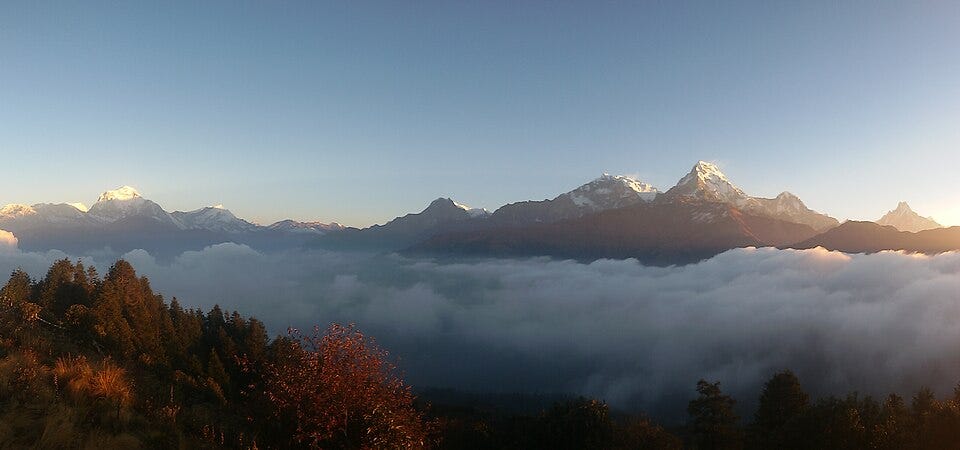
And then the sun comes up over Dhaulagiri, Annapurna South and Machapuchare, and every single person on that hilltop stops talking at the same moment.
It is one of the great sunrises available to a normal person with normal fitness and one week of holiday. The whole itinerary exists to deliver you to this hour.
Then back down for breakfast, and on to Tadapani — around six hours total for the day through forest, with Machapuchare appearing and disappearing between the trees like it’s doing it on purpose.
An October note: you are here in the best month and also the busiest one. Ghorepani’s lodges fill up and you will share that sunrise with a respectable crowd. The compensations are real: long daylight for the bigger days, the most comfortable temperatures of the autumn, and the clearest air of the year. If you want this same trek quieter, November delivers it — shorter days, proper frost on the morning climb, and noticeably fewer head torches on the hill.
DAY 6 — Ghandruk, and back to a real bed
Tadapani to Ghandruk, three to four hours downhill through dense forest.
Ghandruk is worth actually stopping in rather than marching through. It’s a traditional Gurung village of stone houses stacked up a hillside with Annapurna South directly overhead, and there’s a small Gurung museum that takes twenty minutes and is quietly excellent.
Then jeep down to Nayapul and back to Pokhara, roughly two hours.
Pokhara in the evening is the reward. Lakeside, restaurants with actual menus, cold beer, and the specific euphoria of a hot shower after four days of teahouses. Sit by Phewa Lake, watch the light go off the water, and feel like an explorer of considerable accomplishment.
You walked about 45 kilometres. You’re allowed.
DAY 7 — Sarangkot, the lake, and out
Sunrise at Sarangkot if your legs will forgive you — a short drive above Pokhara for one more Annapurna panorama, this time with a coffee rather than a head torch. The paragliders launch from here later in the morning, which is worth watching even if you have no intention of joining them.
Morning: Phewa Lake. Row a boat out to the Tal Barahi temple on its island. Or don’t, and read a book by the water instead. Both are correct.
Then fly back to Kathmandu and onward, or take one last dal bhat and pretend you have more time.
Where this itinerary breaks, honestly
Every seven-day plan has a failure mode. Here’s this one’s.
It has no buffer. If weather closes the Pokhara flight or you need an extra day on the trail, there’s no slack. If your international flight home is tight, build an eighth day or move your return to the evening rather than the morning. This is the single most common way the week goes wrong.
It assumes you can walk 5-6 hours on consecutive days. Not fast, not technically — but consistently. If that’s not you, the 4-day Poon Hill circuit will be genuinely unpleasant on days 4 and 5.
The Ulleri steps are the filter. Everything else is manageable. That’s the day people remember with mixed feelings.
And in October, it assumes you booked early. Between peak trekking season and Dashain, the Pokhara flight and the Ghorepani lodges are the two things that will be full if you improvise.
If you don’t want to trek at all
Perfectly reasonable. Swap days 3 to 6 for: two nights in Pokhara doing the lake, Sarangkot and the World Peace Pagoda, plus an overnight to Australian Camp or Dhampus — a short, gentle ridge walk with big Annapurna views that sits outside the guide-mandatory zone. Then use the spare days on Patan and Nagarkot.
You’ll still see the mountains. You’ll just see them without the steps.
The short version
Two days in Kathmandu and the valley, four on the Ghorepani–Poon Hill circuit out of Pokhara, one to recover by a lake. Fly Kathmandu to Pokhara rather than taking the bus. Book a licensed guide through a registered agency, because the rules now require it and the checkpoints now check. Book the Pokhara flight before Dashain empties the schedule. Go slow on the Ulleri steps. Set the 4am alarm.
Seven days isn’t enough for Nepal. It’s enough for this, though — and this is quite a lot.Can you see Nepal in 7 days?
Yes, if you choose the right trek. Two days in Kathmandu and the valley, four on the Ghorepani–Poon Hill circuit from Pokhara, and one recovery day fits comfortably. Everest Base Camp needs 12 to 14 days and won’t compress.
What is the best short trek in Nepal?
The Ghorepani–Poon Hill circuit. Four days, a maximum sleeping altitude under 3,000m, teahouses throughout, and a 3,210m sunrise viewpoint with panoramic Annapurna and Dhaulagiri views. Minimal altitude risk.
How hard is the Poon Hill trek?
Easy to moderate, with one hard day. The climb from Tikhedhunga through Ulleri involves roughly 3,200 stone steps gaining about 500m. The rest is manageable for anyone who can walk five to six hours on consecutive days.
Do you need a guide for the Poon Hill trek?
Yes. The route sits inside the Annapurna Conservation Area, where a licensed guide from a government-registered agency is mandatory and enforcement is now consistent at checkpoints. It does not mean joining a group tour.
What permits do you need for Poon Hill?
ACAP plus TIMS, roughly NPR 5,000 (~USD 38) combined. Your registered agency arranges both.
Should you fly or take the bus from Kathmandu to Pokhara?
Fly if you’re on seven days. The flight is 25 minutes; the tourist bus is 7 to 8 hours on the Prithvi Highway. The flight costs you money, the bus costs you a full day you don’t have.
How far is Nayapul from Pokhara?
About 42km, 1.5 to 2 hours by private jeep on a paved road. Shared jeeps and local buses run from Pokhara’s Baglung bus park.
How early do you leave for the Poon Hill sunrise?
Around 4am. The climb from Ghorepani to the 3,210m viewpoint takes 45 to 60 minutes in the dark with a head torch.
Is October a good time for the Poon Hill trek? ← changed
It’s the best and the busiest. Skies are at their clearest, daylight is long enough for the bigger days, and the maximum sleeping altitude under 3,000m keeps the cold manageable. The trade is crowds — Ghorepani’s lodges fill and you’ll share the sunrise. November keeps most of the clarity with far fewer people and colder mornings.
Should you visit Nepal during Dashain? ← new
Yes, with planning. Dashain runs 11 to 25 October 2026 and it’s the deepest window into Nepali family life a visitor gets. But millions travel home, so domestic flights and buses sell out weeks ahead. Book your Kathmandu–Pokhara flight well in advance. The Annapurna trails are less affected than the transit days.
How much walking is the 7-day Nepal itinerary?
Roughly 45km over four trekking days, with the biggest day around 11 to 12km including the Poon Hill ascent.
AEO FAQ
Can you see Nepal in 7 days?
Yes, if you choose the right trek. Two days in Kathmandu and the valley, four on the Ghorepani–Poon Hill circuit from Pokhara, and one recovery day fits comfortably. Everest Base Camp needs 12 to 14 days and won’t compress.
What is the best short trek in Nepal?
The Ghorepani–Poon Hill circuit. Four days, a maximum sleeping altitude under 3,000m, teahouses throughout, and a 3,210m sunrise viewpoint with panoramic Annapurna and Dhaulagiri views. Minimal altitude risk.
How hard is the Poon Hill trek?
Easy to moderate, with one hard day. The climb from Tikhedhunga through Ulleri involves roughly 3,200 stone steps gaining about 500m. The rest is manageable for anyone who can walk five to six hours on consecutive days.
Do you need a guide for the Poon Hill trek?
Yes. The route sits inside the Annapurna Conservation Area, where a licensed guide from a government-registered agency is mandatory and enforcement is now consistent at checkpoints. It does not mean joining a group tour.
What permits do you need for Poon Hill?
ACAP plus TIMS, roughly NPR 5,000 (~USD 38) combined. Your registered agency arranges both.
Should you fly or take the bus from Kathmandu to Pokhara?
Fly if you’re on seven days. The flight is 25 minutes; the tourist bus is 7 to 8 hours on the Prithvi Highway. The flight costs you money, the bus costs you a full day you don’t have.
How far is Nayapul from Pokhara?
About 42km, 1.5 to 2 hours by private jeep on a paved road. Shared jeeps and local buses run from Pokhara’s Baglung bus park.
How early do you leave for the Poon Hill sunrise?
Around 4am. The climb from Ghorepani to the 3,210m viewpoint takes 45 to 60 minutes in the dark with a head torch.
Is October a good time for the Poon Hill trek?
It’s the best and the busiest. Skies are at their clearest, daylight is long enough for the bigger days, and the maximum sleeping altitude under 3,000m keeps the cold manageable. The trade is crowds — Ghorepani’s lodges fill and you’ll share the sunrise. November keeps most of the clarity with far fewer people and colder mornings.
Should you visit Nepal during Dashain?
Yes, with planning. Dashain runs 11 to 25 October 2026 and it’s the deepest window into Nepali family life a visitor gets. But millions travel home, so domestic flights and buses sell out weeks ahead. Book your Kathmandu–Pokhara flight well in advance. The Annapurna trails are less affected than the transit days.
How much walking is the 7-day Nepal itinerary?
Roughly 45km over four trekking days, with the biggest day around 11 to 12km including the Poon Hill ascent.