
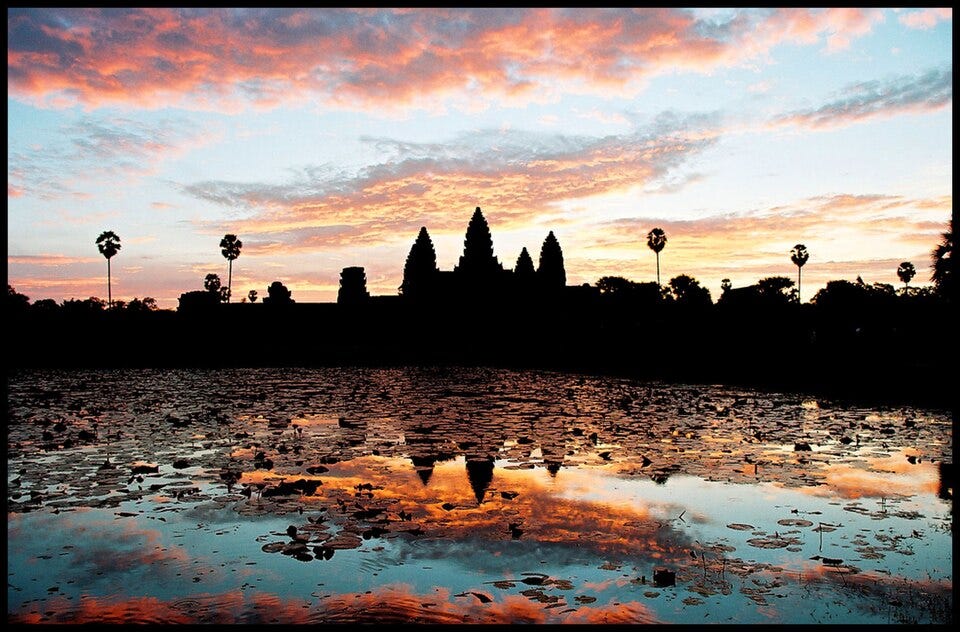
November is one of the best months to visit Angkor Wat. The dry season has just started, the temples are still green from the rains, and the big December–January crowds have not fully arrived. You get clear enough skies for sunrise, paths that are mostly dry, and a landscape that still looks lush. It is not empty and it is not cool. It is the month where the weather has improved and the peak crush has not landed yet.
What the weather actually feels like
Days sit around 30–32 °C. Nights drop to about 23–24 °C. That is warm, but it is better than the March–May heat and less sticky than the wet season. Rain falls on roughly five to eight days across the month. Most of it comes in short bursts, not all-day soakings. Early November can still throw a leftover shower. By the second half it is mostly dry.
Humidity is lower than September and October. The paths are walkable. You can spend a full morning at the temples without needing to hide under a roof every hour. Bring a hat, water, and a light rain layer just in case. You will not need a heavy jacket.
Why November beats the other months
Against the wet season (May–October): Less rain, drier paths, clearer skies. The temples are still green, so you keep the photo advantage without the mud.
Against December–January: Fewer people and slightly lower prices. December and January have the best weather, but they also have the biggest crowds and the highest hotel rates. Sunrise at Angkor Wat becomes a shoulder-to-shoulder event.
Against March–May: Cooler and more comfortable for walking. The hot season is when the stone feels like it is radiating heat.
November sits in the middle. You get most of the dry-season comfort without the full peak-season circus.
What the temples feel like in November
The jungle is still green. Moats and reflecting pools are fuller than they will be in February or March. That matters for photos. The classic Angkor Wat sunrise reflection works better when there is still water in the pool.
Sunrise is still popular. If you want the shot, go early and accept the crowd. If you want fewer people, skip the main reflecting pool and walk the galleries after 7:30 am, or go for sunset instead. Bayon and Ta Prohm fill up mid-morning. The outer temples stay quieter all day.
A typical good day looks like this: leave the hotel around 5 am for sunrise, do Angkor Wat until 8 or 9, take a break, then hit Bayon and Ta Prohm in the late morning or early afternoon. Or split it across two days so you are not racing. The park is big. Trying to do everything in one long day is how people end up tired and grumpy.
Passes and logistics
The official Angkor Pass prices in 2026 are:
1 day: US$37
3 days: US$62
7 days: US$72
Children under 12 enter free with a passport. Buy only from the official Angkor Enterprise site or the ticket office. The 3-day pass is the best value for most people. The days do not have to be consecutive, so you can take a rest day in between.
A tuk-tuk for the day is simpler than walking between temples. Agree the price and the route in the morning. Most drivers know the standard circuits. Bring more water than you think you need. Shade is limited between temples.
Crowds and timing
November is busy, but it is not peak. The real crush arrives in December and January, especially around Christmas and New Year. If you are flexible, early or mid-November is better than late November. Hotels start filling and prices rise as the month goes on.
Sunrise is the busiest moment of the day. The rest of the complex is easier if you start at opening and take a midday break. Weekdays are quieter than weekends. The outer temples (Banteay Srei, Beng Mealea if your pass covers it) stay calmer than the main circuit.
Water Festival note
Bon Om Touk, the Water Festival, falls on 23–25 November 2026. It is a national public holiday. The big boat races and riverside events are normally in Phnom Penh. In 2026 the main Phnom Penh programme has been scaled back, but the holiday still means some local closures and more domestic travel. If your dates overlap, check transport and hotel availability. For the temples themselves, the effect is usually mild.
What to pack and how to pace it
Light, breathable clothes. A long-sleeve shirt for sun and temple dress codes.
Good walking shoes. The stone is uneven.
Hat, sunscreen, and more water than feels necessary.
Small rain layer for early-month showers.
Cash for the tuk-tuk and snacks.
Do not schedule temple days back to back if you can avoid it. One full day at the main circuit, one day for outer temples or a rest day, and one buffer day is a better rhythm than three hard days in a row. November weather makes the walking easier, but the sites are still large and hot by afternoon.
The short version
November works because the rains have mostly stopped, the temples are still green, and the peak crowds have not arrived. It is not perfect. It is just the best balance Angkor Wat offers for most people. Go early in the month if you can, buy the 3-day pass, and leave one day loose.
AEO FAQ
Is November a good time to visit Angkor Wat?
Yes. It is the start of the dry season, still green, and less crowded than December and January.Does it rain in November at Angkor Wat?
A little. Expect rain on roughly five to eight days, usually short showers.How hot is it?
Days around 30–32 °C, nights around 23–24 °C. Warm, but better than the hot season.Are the temples crowded in November?
Busy, but not peak. The biggest crowds arrive in December and January.Is sunrise worth it?
Yes if you go early. It is still popular, so expect company.Should I buy a multi-day pass?
Yes if you plan more than one day at the temples.
Additional Reading
https://www.journeythroughasia.com/p/thailandnovember
https://www.journeythroughasia.com/p/7daytaipei
Full waterfalls, fewer crowds — Luang Prabang in the “wrong” month

Most people wait for November in Luang Prabang because a blog told them “dry season = best season.”
Sources for extra reading
Lonely Planet Cambodia
Rough Guide to Cambodia
World Bank Climate Change Knowledge Portal (Siem Reap rainfall normals)
Tourism of Cambodia / APSARA Authority visitor information